
Commercial Renewables · Cornwall
Renewable Energy for Cornwall's Retail Units and High-Street Shops
Solar PV, heat pump heating, LED retrofit and EV chargers for Cornwall retail — high-street shops, retail parks at Pool, Truro and Bodmin, and standalone units across the duchy. MEES MEES compliance headroom secured ahead of the next tightening.
Cornwall has roughly 6,800 retail units across high streets, retail parks, edge-of-town parades and tourist destinations — from independent boutiques in St Ives and Padstow to national multiples at Pool Innovation Centre, Treliske Retail Park (Truro), Launceston Retail Park, Bodmin Pillmere, Hayle Carnsew Park and Camborne. The sector faces an immovable deadline: from 1 April 2027 it becomes unlawful to grant a new lease, or continue letting under an existing lease, on any commercial property with an EPC rating below C. With approximately 38-42% of Cornish retail units currently rated D or E, the next 22 months will see a frantic compliance scramble. CCS Heating & Renewables works with both retail landlords (REITs, regional property companies, individual high-street freeholders) and tenants (national multiples, local independents, multiple-unit operators) to deliver MEES-compliant retrofit packages combining solar PV, heat pumps, LED, insulation and (where relevant) EV charging. We coordinate the legal interface between landlord works (typically structural and external) and tenant works (typically internal and process-related), bringing clarity to a regulatory area many operators find genuinely confusing.
MEES regulations 2027 — what landlords and tenants actually need to do
The Minimum Energy Efficiency Standards for non-domestic property tightened in stages: from 1 April 2018 it became unlawful to grant new leases on EPC F and G properties; from 1 April 2023 this extended to continued letting of EPC F and G on existing leases; from 1 April tightening commercial MEES requirements. Penalties for non-compliance reach £150,000 per property per breach.
Critical clarifications often misunderstood:
- Landlord, not tenant, holds primary legal liability — the regulation prohibits the landlord from granting/continuing the lease, regardless of who funded the works
- EPC validity is 10 years — a 2017 EPC remains valid until 2027 unless the property has been substantially altered
- Some exemptions apply — including the 7-year payback test, third-party consent refusal exemption, and devaluation exemption — but these require formal registration on the PRS Exemptions Register and last 5 years
- Listed buildings are NOT automatically exempt — common misconception; only specific energy improvements that would unacceptably alter character are exempt
- Lease structure matters — internal repair vs full repairing vs FRI fundamentally affects who bears retrofit cost
For retail unit landlords with multi-let properties (typical for parade-style high streets and retail parks): the works typically required to lift EPC from D or E to C include solar PV (1-2 SBEM points), heat pump replacing electric panel heating or old gas (3-6 points), LED retrofit (1-2 points), loft or roof insulation (1-3 points). A typical 200m² retail unit retrofit costs £18-42k depending on starting EPC and existing systems.
Solar PV on retail unit roofs — single-tenant and multi-let scenarios
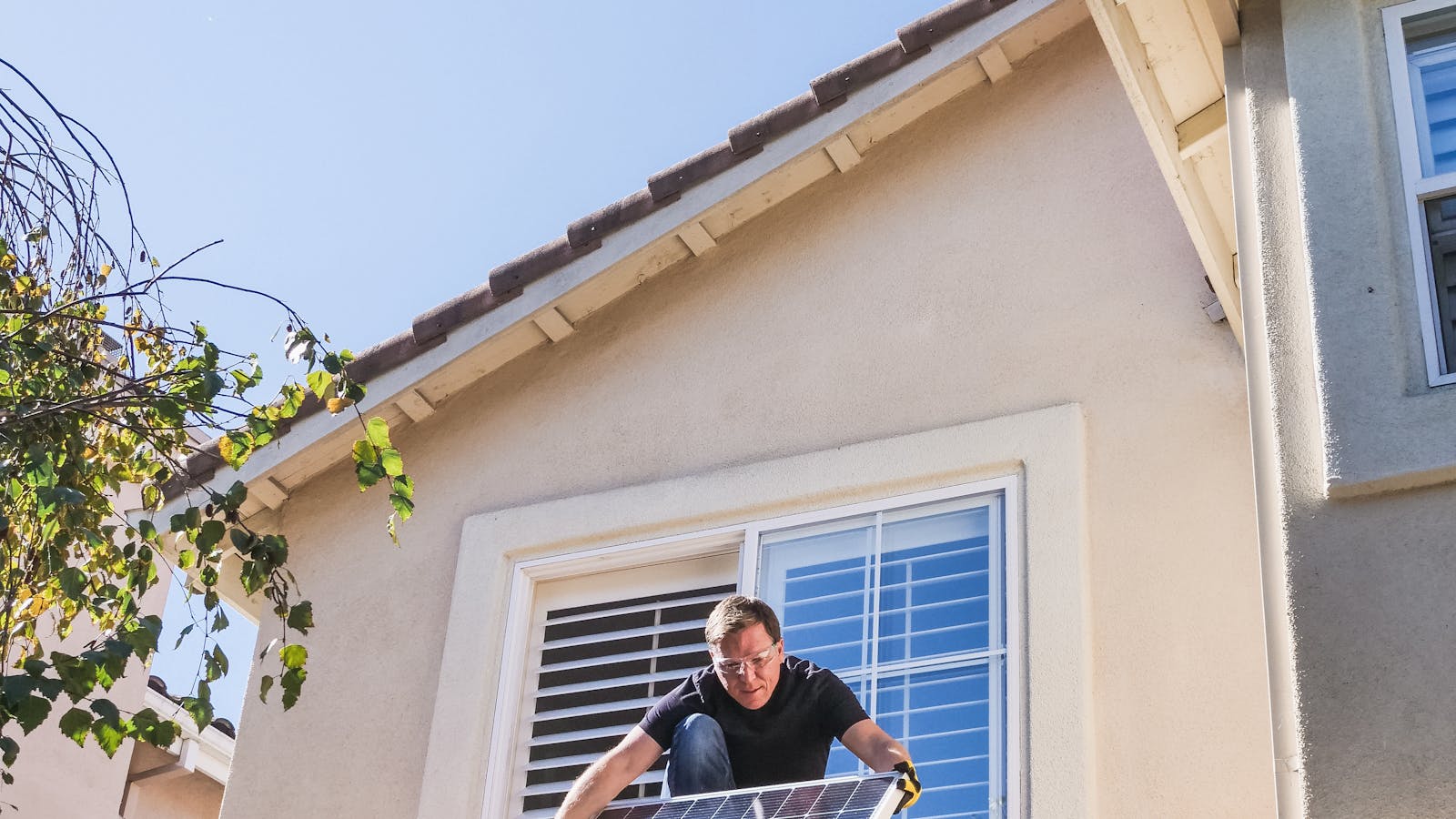
Most Cornish retail units have flat or shallow-pitched roofs of 100-800m² — capable of carrying 8-90 kWp of commercial solar PV. Standalone units (drive-throughs, supermarket out-of-town, large format retail) often take 100-300 kWp on their roof envelope alone.
Self-consumption varies enormously by retail type:
- Convenience stores (Co-op, Sainsbury's Local, Tesco Express) — extended hours, high refrigeration load, 75-92% self-consumption
- Supermarkets — 70-85% self-consumption, payback 4.5-6 years on 100-300 kWp arrays
- Comparison goods retailers (clothing, homewares) — daytime trading hours, 55-70% self-consumption
- Coffee shops, food takeaways — high daytime kitchen load, 70-85% self-consumption
- Furniture, white goods — moderate daytime load, 50-65% self-consumption
For multi-let retail parades the install logic gets more complex. Options:
- Landlord-owned array supplying common areas with surplus exported under SEG — simplest, no tenant involvement needed
- Landlord-owned array supplying tenants via private wire — requires legal agreement and metering, but maximises self-consumption value
- Tenant-funded individual arrays on demised roof areas — works for sole-occupier units, complex for shared roofs
- Roof-rental PPA — third party owns array, leases roof from landlord, sells power to tenants directly
We've delivered nine multi-let retail park solar projects across Cornwall and the South West since 2023, including private wire arrangements with Sainsbury's, Aldi and three regional retail park operators.
Heating retrofit — replacing electric storage heaters and old gas
A surprising proportion of Cornish retail units still heat with electric storage heaters (1980s-90s installations, particularly in older parades) or old gas combi boilers nearing end of life. Both push EPC ratings into the D-E range and both will struggle to support EPC C compliance.
For retail units the standard heat pump retrofit is a 7-25kW air-source unit (Mitsubishi Ecodan, Vaillant aroTHERM plus, Daikin Altherma 3 R) feeding either an upgraded radiator system (existing pipework retained, radiators upsized 20-40%) or a fan-coil/cassette system for shop-front units where wall-mounted radiators are impractical. The fan-coil approach (Mitsubishi Mr Slim, Daikin VRV, Toshiba SMMS) doubles as summer cooling — increasingly demanded by retail tenants, particularly for IT-heavy retail and food retail.
Hot water demand for retail is typically modest (washroom only) and handled by point-of-use electric instantaneous heaters or a small unvented cylinder fed from the heat pump. The exception is food retail (cafés, takeaways, butchers, bakers) where higher hot water demand mirrors hospitality — see our hospitality page.
EPC point uplift from electric storage heater replacement: typically 4-7 SBEM points, often the single biggest move from D/E to C. Combined with LED, insulation and PV the package reliably delivers EPC C rating.
EV charging at retail parks and high streets
Retail EV charging splits into three segments: destination charging at retail parks (50kW+ rapid, 30-90 min dwell time), workplace charging for staff (7-22kW, 8-hour dwell), and high-street kerb-side charging (7kW, all-day dwell).
Retail park rapid charging is increasingly delivered through host arrangements with specialist providers (GRIDSERVE, Osprey, MFG, BP Pulse, Tesla Destination, Connected Kerb) where the operator funds and owns the equipment, paying the landlord rent and revenue share (typically 8-15% of net charging revenue). Zero capex for the landlord, immediate amenity uplift driving footfall. We provide the underlying electrical infrastructure design and DNO coordination — typical 6-bay 50kW retail park installation needs 350kVA supply uplift, 6-9 months DNO process.
For high-street and individual retail units the OZEV Workplace Charging Scheme remains the primary funding route — £500/socket × up to 40 sockets for staff bays. The Plug-in Van Grant (£5k small, £25k large) supports retail delivery van electrification, particularly relevant for Cornish independent retailers running their own fleet (Padstow, St Ives, Truro independents typical).
Smart load management essential for combining EV with solar and heat pumps on a typical 100-200kVA retail supply — we use the Sunsynk MAX, EO Hub or Project EV LMS controllers depending on equipment compatibility.
LED retrofit, insulation and the finishing touches
LED lighting retrofit is the highest-IRR EPC improvement available — typically 1-3 SBEM points for £4-12 per m², payback under 24 months on commercial lighting bills. For Cornish retail we increasingly specify smart LED (Casambi, Helvar) with daylight-responsive dimming, occupancy sensing and DALI-controlled scenes. Combined with skylight retrofit (where structurally possible) the visual quality of retail interiors improves substantially while energy use drops 60-75% versus legacy fluorescent or halogen.
Insulation works for retail typically focus on roof-level (loft top-up to 270mm, or warm-roof retrofit on flat roofs) and shopfront thermal performance (secondary glazing, draught-stripping on entrance doors, air-curtain installation at shop entrance). External wall insulation rarely viable for high-street retail due to shopfront heritage and party-wall issues.
For retail park standalone units, full warm-roof retrofit during planned roof maintenance can lift the building's U-value from 0.25 to 0.10 W/m²K, often unlocking the final 1-2 EPC points needed for C rating. We coordinate with roofing contractors (typically TaylorMade Roofing, Cornish Roofing or Westcoast Roofing) on programme.
The full retail package — solar PV, heat pump, LED, insulation, optional EV — typically takes a 1990s-built 250m² retail unit from EPC E (110-130) to EPC B (45-60), well clear of the 2027 MEES C threshold. Capex £35-65k depending on starting condition, payback 5.5-7.5 years on combined fuel saving and rental retention value.
Funding, finance and the landlord-tenant cost split
2026 funding stack for Cornish retail:
- IETF Phase 3 — 30% capex above £100k for energy efficiency (relevant for multi-unit landlord portfolios)
- Workplace Charging Scheme — £500/socket × up to 40 sockets
- SEG export 12-15p/kWh
- SWIG Finance — Cornish CDFI for SME retail
- 100% Annual Investment Allowance — full first-year capex deduction on plant up to £1m
- 50% first-year allowance — solar PV is special rate plant, so above the AIA it takes the 50% FYA, not Full Expensing
- 0% APR finance through our CCS finance partner for installs up to £50k
- PPA structures for solar with zero capex
The landlord-tenant cost split for MEES compliance works varies by lease:
- FRI (full repairing and insuring) lease — tenant typically responsible for internal works and shopfront, landlord for structural and external. Solar PV and external heat pumps usually landlord-funded; internal LED, fan-coil units, electrical board upgrades typically tenant-funded
- Internal repair lease — landlord funds most works, recovers via rent at lease renewal
- Effectively FRI with service charge — most multi-let retail parks; landlord does works and recovers via service charge
We provide separate landlord and tenant scopes/quotes where requested, plus a combined master document for legal review by the operator's solicitor. Several Cornish landlord clients have us survey their entire portfolio annually, ranking units by retrofit urgency against MEES exposure.
Case Study
300m² Retail Unit, Pool Retail Park
32kWp PV + 18kW ASHP + LED + insulation. EPC E to B. £8,400/yr saved. MEES-compliant 14 months ahead of deadline.