
Commercial Renewables · Cornwall
Renewable Energy for Cornwall's Listed Pubs and Historic Inns
Heat pumps and solar for Grade II and Grade II* listed pubs across Cornwall — designed to satisfy Listed Building Consent, hidden where possible, conservation-officer approved, and respectful of original fabric from cob walls to bare-brick chimney breasts.
Cornwall has approximately 1,800 listed pubs, inns and former coaching houses still trading or converted to mixed hospitality use — one of the densest concentrations of listed hospitality in England. Many of these buildings predate 1700, with cob, granite, slate-hung timber and rare 16th-century earth-floor construction. Their owners face a uniquely difficult problem: rising energy costs and the looming 1 April tightening commercial MEES requirements, against a regulatory environment (Listed Building Consent under the Planning (Listed Buildings and Conservation Areas) Act 1990) that prevents most of the standard renewable retrofit playbook. CCS Heating & Renewables has delivered 19 listed pub renewable installs across Cornwall since 2022, working with operators from Cornish Inns Limited and St Austell Brewery tenanted estate through to single-pub freeholders in West Penwith and the Roseland. Our listed buildings approach centres on three principles: fabric first (insulation that works with breathable walls, not against them); hidden plant (heat pumps screened or basement-located, in-roof PV indistinguishable from slate at distance); and pre-application engagement (every project starts with a Cornwall Council conservation officer site visit before design begins).
Listed Building Consent — what conservation officers actually accept in 2026
Listed Building Consent (LBC) is mandatory for any works affecting the special architectural or historic interest of a listed building, internal or external. For listed pubs the typical concerns are: external plant visibility, roof-mounted equipment, exposed cabling, drilling through historic fabric (cob, lime mortar, pre-1900 stone), and impact on traditional joinery, panelling and fireplaces. Cornwall Council Conservation officers (covering different patches across the duchy) have varying tolerance — but consistent themes have emerged in 2024-26.
Generally accepted:
- In-roof integrated PV (Viridian Clearline Fusion, GSE In-Roof, Solarcentury C21e) on roofslopes not visible from primary views
- Heat pumps located in courtyards, behind walls, in cellars (with adequate ventilation), or on flat outshut roofs
- Cellar-located ASHP with ducted air supply and acoustic attenuation
- UFH retrofit only where existing floor is non-historic (most pre-1850 floors will be refused)
- Internal pipework run in surface-mounted PassivPipe pre-insulated copper, painted to match plaster colour, where chasing would damage historic fabric
- Battery storage in non-historic outbuildings or modern extensions
Generally refused:
- External wall insulation on lime-rendered or exposed-stone elevations
- Standard rooftop PV arrays on prominent slate roofs
- Drilling through cob walls for refrigerant lines (cob is irreplaceable historic fabric)
- Replacement of historic timber sash windows with double glazing (secondary glazing accepted)
- External condenser units visible from public realm without screening
Pre-application discussion (free, typically 4-6 weeks for a written response) is mandatory. We attend every pre-app meeting with our heritage architect and present sketch options. The full LBC application takes 8-13 weeks for determination.
Cellar and outshut heat pump installations
The single most common listed pub heat pump approach in 2026 is cellar location with ducted air supply. A monobloc air-source heat pump (Mitsubishi Ecodan, Daikin Altherma, Viessmann Vitocal) is sited in the cellar with: a 600mm-diameter insulated air supply duct drawn from a discreet external grille (often hidden behind a chimney breast or in a coalhole opening); an equally large exhaust duct discharging to a low-visibility location; and acoustic attenuation throughout. The system runs visually identical to an existing oil or gas plant — no external condenser units anywhere in the conservation curtilage.
Performance penalty for cellar location is real: SCOP typically drops 0.3-0.5 versus an equivalent external installation due to fan power on the supply ducting and slightly lower air temperatures in the cellar than outside (in summer; reverse in winter, when cellar air is actually warmer than ambient and helps performance). Net annual penalty around 5-9%, easily justified by the LBC consent.
For pubs without suitable cellars, courtyard or outshut roof installations work well. Outshut roofs (the lower lean-to roofs over scullery, pantry, washroom additions) typically already carry condenser units for refrigeration and are familiar to conservation officers. We acoustic-screen with stone-faced bunds matching local material — Delabole slate, Polyphant stone, granite — sourced from Cornish quarries.
In-roof PV — the conservation-acceptable solar route
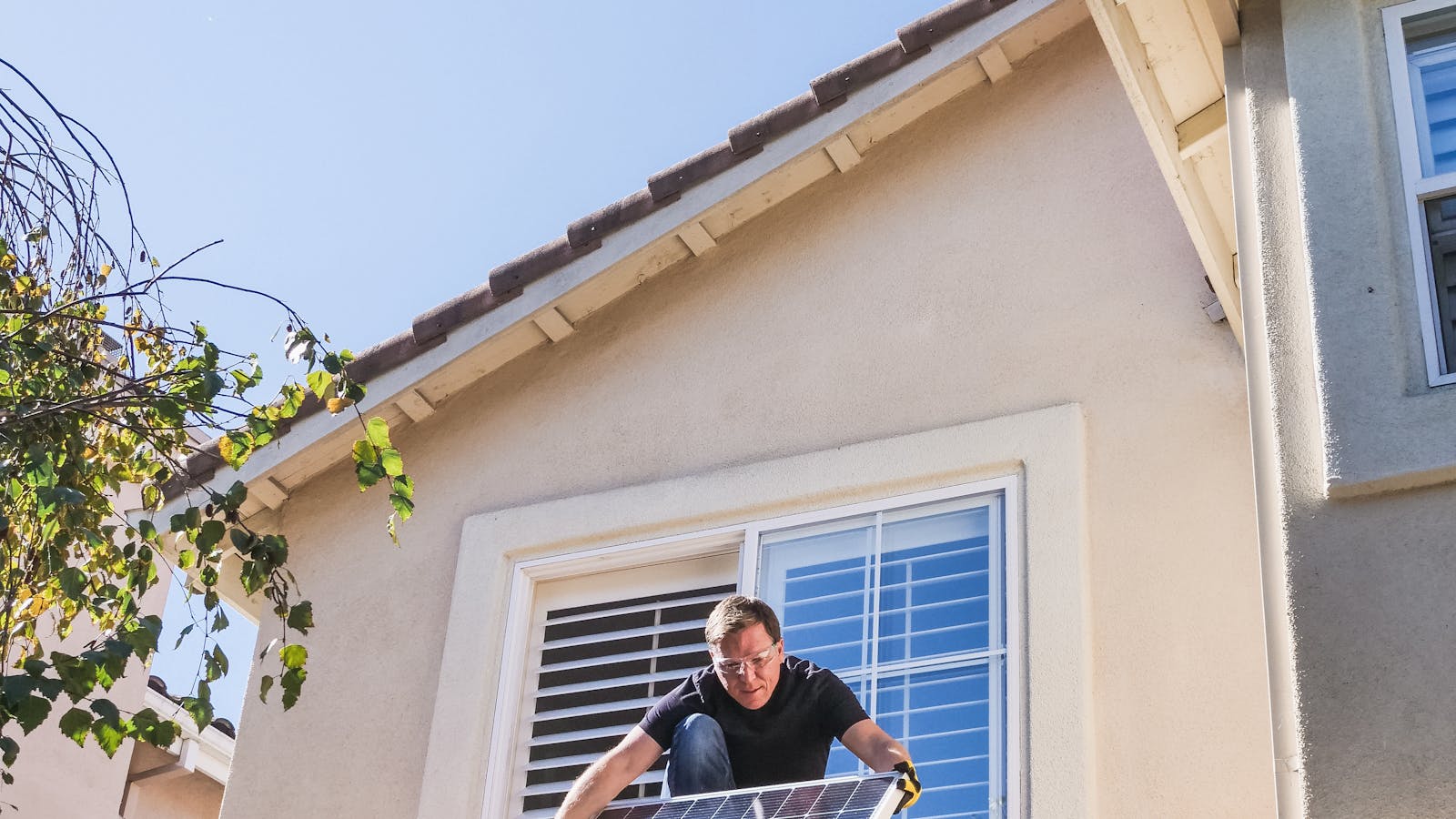
Standard rail-mounted solar panels sit 100-150mm proud of the roof slope and are immediately recognisable as PV. Conservation officers routinely refuse them on listed slate or pantile roofs visible from primary public views. In-roof integrated PV sits flush with the surrounding tile or slate plane, framed in a flashing kit that matches the roof colour, and reads as a darker section of roof rather than as discrete equipment.
Three preferred products in 2026:
- Viridian Clearline Fusion — UK-manufactured, slate-grey frame, 405-435W modules, 25-year product warranty
- GSE In-Roof — French-manufactured, lower profile, 410-450W modules, particularly good for steep roofs
- Solarcentury C21e Solar Tile — discontinued for new sales but available refurbished for spot replacement
Capex uplift over standard rail-mount typically 15-25%. Performance penalty roughly 3-7% lower yield due to slightly higher operating temperatures from reduced rear ventilation. For a 12 kWp listed pub array generating 11,200 kWh annually instead of 11,800 kWh annually, the trade-off is invariably worth it for conservation consent.
Alternative for refused roof installations: ground-mount solar on car park canopies (where the pub has a separate car park), or PV on adjacent non-listed outbuildings (modern garages, kitchen extensions) connected back to the pub's main supply.
Bare brick, panelling and the radiator question
Listed pub interiors typically feature exposed lime plaster, cob, granite, original timber panelling, inglenook fireplaces and bare-brick chimney breasts — all of which constrain heating system retrofit. Radiator placement in a 17th-century snug means choosing between historic settle, panelling, fireplace surround and small windows. Standard contemporary radiators look wrong and conservation officers may object.
Our approach: cast-iron column radiators (Carron, Castrads, Bisque cast-iron range) replicating Victorian/Edwardian originals, sized for ASHP-friendly 50°C flow rather than traditional 75°C boiler flow. These look correct in a Georgian or Victorian pub interior and many landlords prefer them aesthetically to the modern panel radiators they replace. Capex uplift £150-£400 per radiator over standard panel equivalents.
For very early buildings (pre-1700, particularly West Penwith and Lizard pubs), where any radiator is intrusive, we deploy hidden trench heating (Jaga Mini Canal, Hudevad Plinth) recessed into existing floor structures where consented, or low-profile under-bench plinth heaters in seating areas. UFH is rarely an option due to historic floor preservation but where existing flooring is post-1900 concrete or modern flag, we can sometimes integrate.
Surface-run pipework using PassivPipe or similar pre-insulated copper, painted to match plaster colour, is increasingly accepted by conservation officers as preferable to chasing channels through 400-year-old cob walls. The visible pipework is genuinely hard to see at distance and reversible.
Tenant arrangements, brewery estates and capex responsibility
Many Cornish listed pubs are tied or tenanted through pub companies (St Austell Brewery, Cornish Inns Limited, Punch Pubs, Stonegate, Admiral) or independent freehold landlords. The capex responsibility for renewable upgrades varies enormously by lease structure:
- Free-of-tie freehold — landlord/operator funds and benefits
- St Austell Brewery tied tenancy — typically capex split via lease variation, with operator paying through differential rent
- Punch/Stonegate/Admiral tenancy — increasingly seeing pubco-funded green retrofit programmes since 2024
- Independent freehold leased to operator — case-by-case lease negotiation
For MEES compliance the legal liability sits with the landlord (the party granting the lease), not the operator. Many listed pub landlords across Cornwall are now actively funding renewable retrofit specifically to maintain MEES compliance through April 2027 and beyond. We work with both sides — providing landlord-only quotes for pure capex projects, and combined operator/landlord quotes where lease variations split the cost.
Funding routes for listed pubs:
- IETF Phase 3 — 30% capex above £100k
- Historic England Heritage Action Zone grants where applicable (Falmouth, Penzance and Truro all have current schemes)
- National Lottery Heritage Fund — for community-owned pubs particularly
- 0% VAT on heat pumps until at least 2027 (residential rate; commercial pubs pay standard rate but with full input VAT recovery)
- 100% Annual Investment Allowance on plant up to £1m
Project delivery in occupied historic buildings
Most listed pubs continue trading throughout install. Programme constraints:
- No noisy works during opening hours (typically 11:00-23:00) — restricts disruptive activity to mornings only
- Cellar works coordinated around drayman delivery schedule and beer cellar temperature stability
- Conservation oversight on every fabric-touching activity — site visits from Cornwall Council conservation officer typically twice during install
- Heritage architect retained on every job — we use Tarrant Heritage Architects (Truro) or Locus Conservation (Penzance) depending on geography
- Specialist trades for cob repair, lime plaster, slate matching where any incidental damage occurs
- Photography record of all original fabric before, during and after works — submitted to conservation officer on completion
Typical listed pub heat pump install runs 4-7 weeks total, of which 2-3 weeks is on-site disruption to operator. PV install adds 1-2 weeks roof time. We schedule wherever possible for the trade-quiet January-March window. Most pubs continue trading throughout with cellar bypass arrangements and temporary heating where the existing boiler must come out before the heat pump goes in.
Post-install, we provide a documented works pack to the operator and landlord, including conservation officer sign-off, all warranties, O&M manuals, BMS access details, and a recommended maintenance schedule. Listed building plant requires slightly more frequent inspection than standard commercial — typically twice-yearly versus annual.
Case Study
Grade II Listed Inn, near Falmouth
Cellar-located 16kW ASHP + 12kWp in-roof PV. EPC F to C. £8,200/yr saved. LBC approved first time.