
Commercial Renewables · Cornwall
Renewable Energy for Cornwall's Schools and Academies
PSDS-funded heat pump and solar retrofits for primary, secondary and academy schools across Cornwall — programmed around term time, designed to BS EN 12831, and delivered in partnership with Cornwall Council and the Department for Education.
Cornwall has 250+ state schools educating around 75,000 pupils, plus a further 25 independent schools. The estate is overwhelmingly heated by mains gas, oil and LPG with average building age of 47 years and EPC ratings clustered around D and E. The sector faces three converging pressures in 2026: the DfE's Sustainability and Climate Change Strategy commitments to net zero by 2050; the commercial MEES requirement for a rising commercial MEES minimum (EPC E today, with further tightening proposed) on leased school properties (relevant to many academy trust holdings); and the rapidly closing window on Public Sector Decarbonisation Scheme Phase 4 funding which has £1.17bn allocated for 2025-28 with applications competitive and oversubscribed. CCS Heating & Renewables has delivered six PSDS-funded school projects across Cornwall since 2023, working with single primaries through to multi-academy trusts running 8-12 sites. We coordinate with Cornwall Council Education, individual MAT estates teams, Salix Finance, the DfE's Get Help with Energy Bills programme, and (for capital projects) the School Condition Allocations process.
Public Sector Decarbonisation Scheme — the funding reality in 2026
PSDS Phase 4 (2025-28) committed £1.17bn nationally to public sector heat decarbonisation and energy efficiency. Phase 3c (the most recent fully-allocated round) was 4.6x oversubscribed. Phase 4a opened in October 2025 with a £230m initial allocation and closed within 11 days. Phase 4b is scheduled for autumn 2026. The competitive landscape means applications must be exceptional — well-evidenced, fully designed, with genuine technical readiness — to succeed.
Eligibility for schools: maintained schools (community, foundation, voluntary aided/controlled) apply via Cornwall Council. Academies and free schools apply directly. Independent schools are not eligible for PSDS, and Salix's interest-free lending is devolved to Scotland and Wales, so it is not a route for an English school either. When a phase is open, PSDS funds 100% of eligible capex for heat decarbonisation (heat pumps, district heating connection, low-temperature emitter upgrades) and matched energy efficiency works (insulation, glazing, LED) — but Phase 4 was the final phase and there has been no open application window since November 2024, so no English school can build a 2026 project around it. Solar PV is eligible only as part of a broader heat decarbonisation project, not standalone.
Our PSDS application support includes: full thermal modelling (TM54 Operational Energy Estimating), Heat Decarbonisation Plan to PSDS template, MEEP cost-benefit assessment, project programme aligned to PSDS delivery timescales (works typically must complete within 18-24 months of grant award), Salix portal submission, and post-award delivery monitoring. Salix Finance interest-free loans bridge any gap between PSDS grant and total project cost, repayable from quantified energy savings over up to 8 years.
Heat pumps in school buildings — the system design
School heat pump retrofits face several constraints unique to the sector: high peak morning warm-up loads (the building must reach 19-21°C from frost-protect by 08:30 Monday morning), low weekend and holiday demand (system must run at very low part-load efficiently), high internal gain variability (full classrooms generate 12-20kW each in addition to heating), and aggressive ventilation requirements under current DfE BB101 guidance.
Our standard primary school spec (5-form entry, 350 pupils): cascade 2-3 x 30-50kW air-source heat pumps (Mitsubishi Ecodan, Daikin EWAQ or Carrier AquaSnap), feeding existing radiator system upgraded with appropriate emitters where required, with a 2,000-3,500L thermal buffer to absorb morning warm-up demand. Weekend setback to 12°C frost protection, weekday optimum-start control via BMS (Trend, Tridium, Schneider).
Secondary school spec scales up to cascades of 3-5 x 60-120kW units, often with chilled water capability for the small but growing summer cooling demand in IT suites and exam halls. We typically retain existing wet system pipework and radiators where they're sized appropriately, adding fan-coil units only in glazed circulation spaces and exam halls where temperature recovery speed is critical.
Critical design considerations:
- BS EN 12831 Heat Loss Calc mandatory — no rule-of-thumb sizing
- Acoustic compliance with BB93 critical — heat pump units sited away from teaching spaces, acoustic enclosures where needed
- Optimum-start algorithms tuned to building thermal mass — we typically use TM52 dynamic modelling
- Heat pump units protected from vandalism and ball impact — robust steel cages or rooftop siting
- Coordination with existing BMS or supply of new BMS — required for PSDS reporting
Solar PV on school buildings
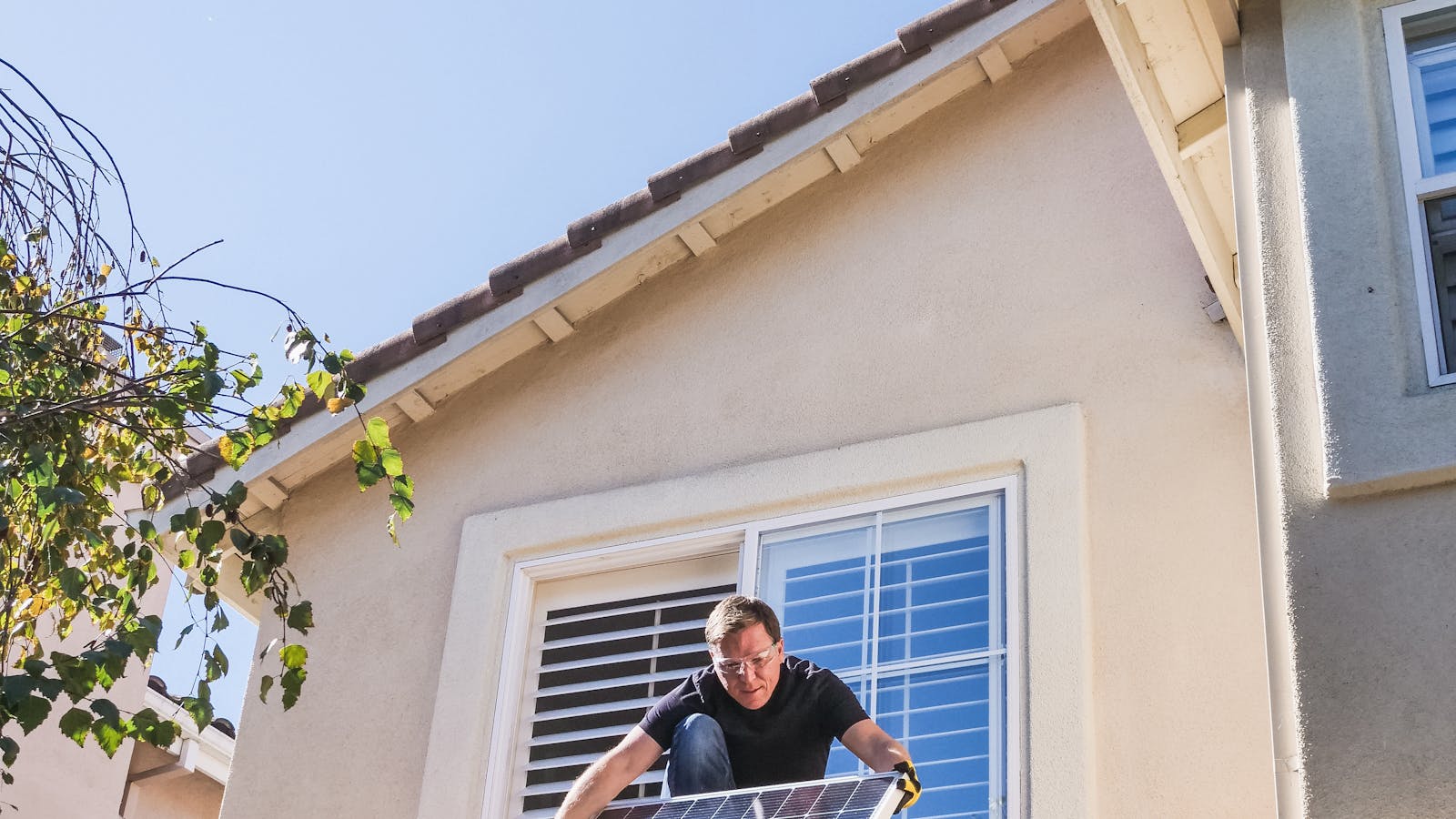
School roofs are excellent solar substrate — large, mostly south-facing or east-west, structurally over-engineered to 1990s+ Building Regs, and almost always available without planning consent under permitted development for state schools. Cornwall's 1,298 kWh/m²/yr irradiance means a 50 kWp primary school array generates 47,000-55,000 kWh annually; a 200 kWp secondary array delivers 190,000-220,000 kWh.
Self-consumption profile is strongly seasonal: term-time weekday daytime demand absorbs 70-85% of generation, but holidays and weekends drop self-consumption to 20-35%. Net annual self-consumption typically lands at 50-65% — meaningful but lower than commercial sites with continuous occupancy. SEG export tariffs (12-15p/kWh) make the unconsumed export still economically valuable.
Funding routes for school solar: PSDS funds solar only as part of broader heat decarbonisation packages. Standalone solar can be funded by: Salix interest-free loans (repayable from energy savings); School Condition Allocations capital budget (for works coinciding with planned roof replacement); MAT central capital reserves; Cornwall Council's Climate Emergency Capital Programme; or third-party PPA where the school buys power back at fixed sub-market rate with no capex.
We've delivered 14 school solar projects in Cornwall since 2022, with average size 65 kWp and average payback 6.8 years on Salix-funded direct purchase. PPA structures typically deliver 25-35% bill savings from day one with zero capex.
EV charging, school transport and the parent run
Schools are increasingly under pressure to provide EV charging for staff, school transport providers, and (in secondary schools) sixth-form student vehicles. The Workplace Charging Scheme provides £500/socket × up to 40 sockets for staff bays. The LEVI fund routed via Cornwall Council can cover public-facing chargers where the school enters a community access agreement (typical out-of-hours public access).
Standard primary school spec: 2-4 x 7kW staff bays (WCS-funded). Standard secondary school spec: 4-8 x 7-22kW staff and minibus bays (WCS plus Salix), with sixth-form access where applicable. Smart load management essential — school grid supplies are often modest (60-100kVA typical primary) and unmanaged EV charging can trip incoming protection.
School minibus electrification: Mercedes eSprinter, VW ID.Buzz, Renault Master E-Tech all viable for typical Cornish school transport routes (10-40 mile daily). Plug-in Van Grant remains £5k (small) or £25k (large) until at least April 2027. School-rated 4x4 EVs (e.g. Hyundai Ioniq 5, Kia EV9) work for outdoor education and farm-school operations. Total fleet electrification typically saves 60-75% on running costs against equivalent diesel.
Term-time programming and the 6-week summer window
School installs live or die by the term-time programme. Major plant room works, boiler removal, pipework upgrades, and any internal works affecting classrooms are scheduled for the six-week summer holiday (typically 19 July-2 September). External works (solar PV, EV chargers, ASHP external positioning) are scheduled around half-term breaks plus term-time evenings and weekends where consented by the headteacher.
Our standard school programme:
- Easter-pre-summer (April-mid-July) — site enabling, scaffolding to roof, electrical containment, plant room preparation
- Summer holiday (6 weeks) — boiler removal, ASHP installation, thermal store install, pipework upgrades, commissioning, Legionella testing
- Autumn term — final commissioning, BMS tuning, staff training, snagging
- October half-term — final adjustments, completion handover
This means PSDS-funded projects typically run on a 12-18 month programme from grant award: 4-8 months design and procurement, 6-week summer install, 3-6 months optimisation. Late grant awards (post-March) often slip to following summer. We recommend starting design work the autumn before intended install summer.
We operate full DBS-checked teams on every school site, with a designated CCS project manager liaising directly with the headteacher, business manager and MAT estates lead. Site safety paramount — segregated compound, pedestrian routes, daily H&S briefing, no public access during works.
Cornwall Council partnership and the wider funding landscape
Cornwall Council operates several relevant programmes for schools:
- Climate Emergency Capital Programme — capital funding for heat decarbonisation in council-controlled buildings including maintained schools
- Schools Energy Co-operative — collective procurement of solar PPAs for member schools, currently 22 Cornish schools enrolled
- LEVI EV Infrastructure Fund — public-facing chargers at school sites with community access
- Cornwall Heat Network feasibility studies — for clusters of public buildings including schools in town centres (Truro, Penzance, Camborne, Redruth and Bodmin all have active studies)
The DfE-route funding stack:
- PSDS Phase 4 via Salix Finance — 100% capex on heat decarbonisation
- School Condition Allocations — devolved capital budget for academies and MATs, eligible for energy works coinciding with condition repairs
- School Rebuilding Programme — full new builds with heat pump and solar specified by default in 2026 cohort
- DfE Get Help with Energy Bills — energy efficiency support and procurement guidance
For independent schools: Salix loans (charitable trust eligibility check), Charity Commission-approved investment, asset finance, and parental capital appeal programmes are the typical routes. We've supported four independent Cornish schools through alternative funding stacks since 2024.
Case Study
Primary School, Camborne area
PSDS-funded retrofit: cascade 2x40kW ASHP + 60kWp solar + LED + insulation. EPC E to B. £14k/yr saved. Net cost £0.